


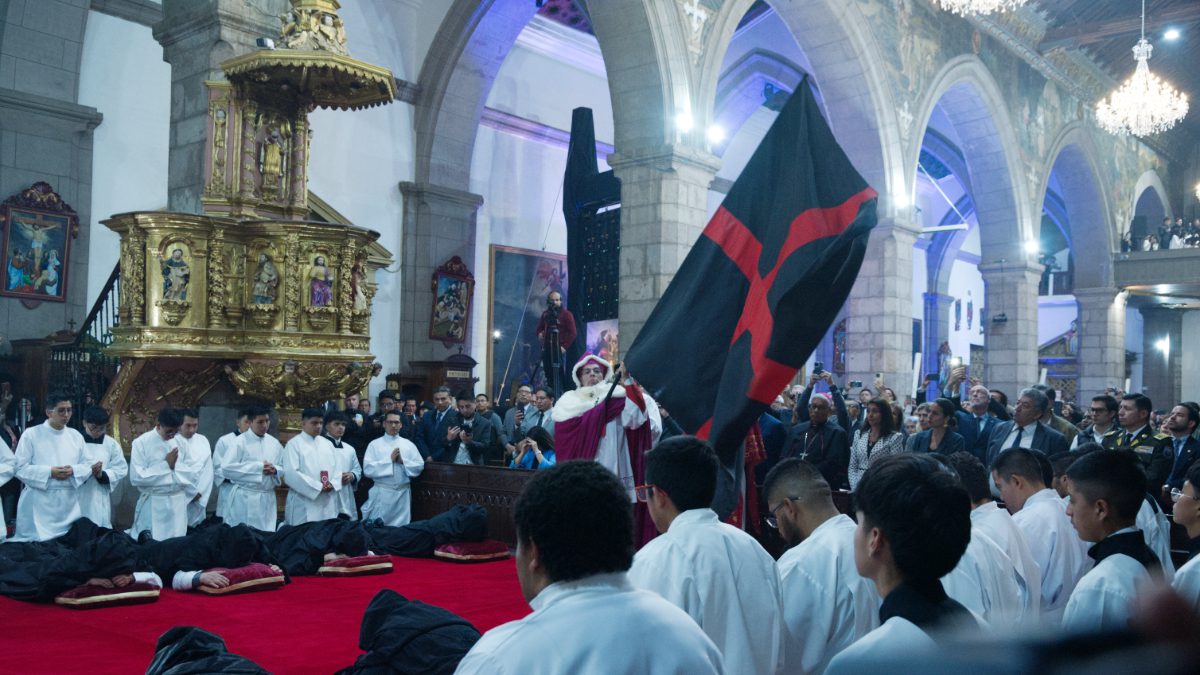
Last year marked my second time attending the Arrastre de Caudas in Quito—an unusual tradition for someone who isn’t Catholic. And yet, I keep coming back.
There is something about Catholicism in the Andes that feels different from what I’ve experienced in the United States or Europe. Yes, there are beautiful churches everywhere, but here, the faith feels older and more complex. It carries echoes of Indigenous worldviews that persist, woven into the fabric of Andean Christianity. It is not my father’s version of a Catholic church.
The Arrastre de Caudas, however, stands apart. The rite harks back to ancient Rome with nary an Indigenous touch. It is a military funeral ritual for fallen generals that eventually made its way into Catholic Holy Week in Sevilla, Spain. Today, only a few places hold the ceremony and one of the most well known takes place in Quito, Ecuador.
This ancient ceremony lives larger than life in modern day Quito and takes place each year on the Wednesday before Easter.
The Setting for the Arrastre de Caudas
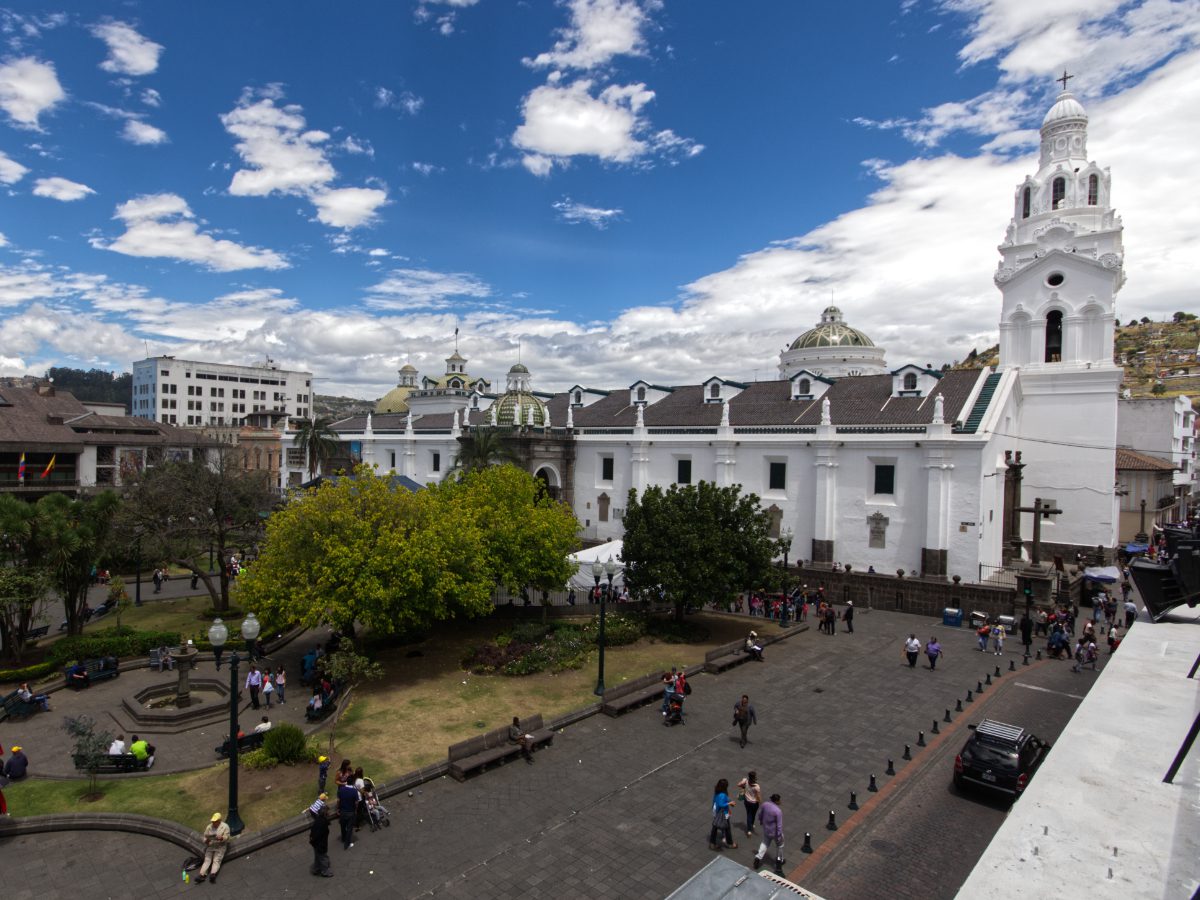
Home to the Arrastre de Caudas, the Quito Metropolitan Cathedral sits along the edge of Plaza Grande, anchoring what feels like a textbook example of a Spanish colonial plaza.
The cathedral itself is impossible to ignore. Its whitewashed walls catch the equatorial light, bright on sunny days, almost glowing when the sky turns overcast and gray. I love it best at night, when the city lights reflect off its white walls. Its domes, tiled in a checkered pattern of greens and yellows, rise above the square, and a weather vane, one with its own story, marks the direction of the wind.
On most days, tourists enter from the side, through a heavy doorway framed in volcanic stone brought down from Pichincha Volcano.
But not on the day of the Arrastre de Caudas. For this special event, the normal entrance for tours is reserved for dignitaries and press. Everyone else enters through the not often opened front doors, the ones facing the Cultural Center across the plaza.
Waiting to Enter
Anyone can attend the Arrastre de Caudas.
There are no tickets or reservations. You show up, you wait, and you hope you arrived early enough.
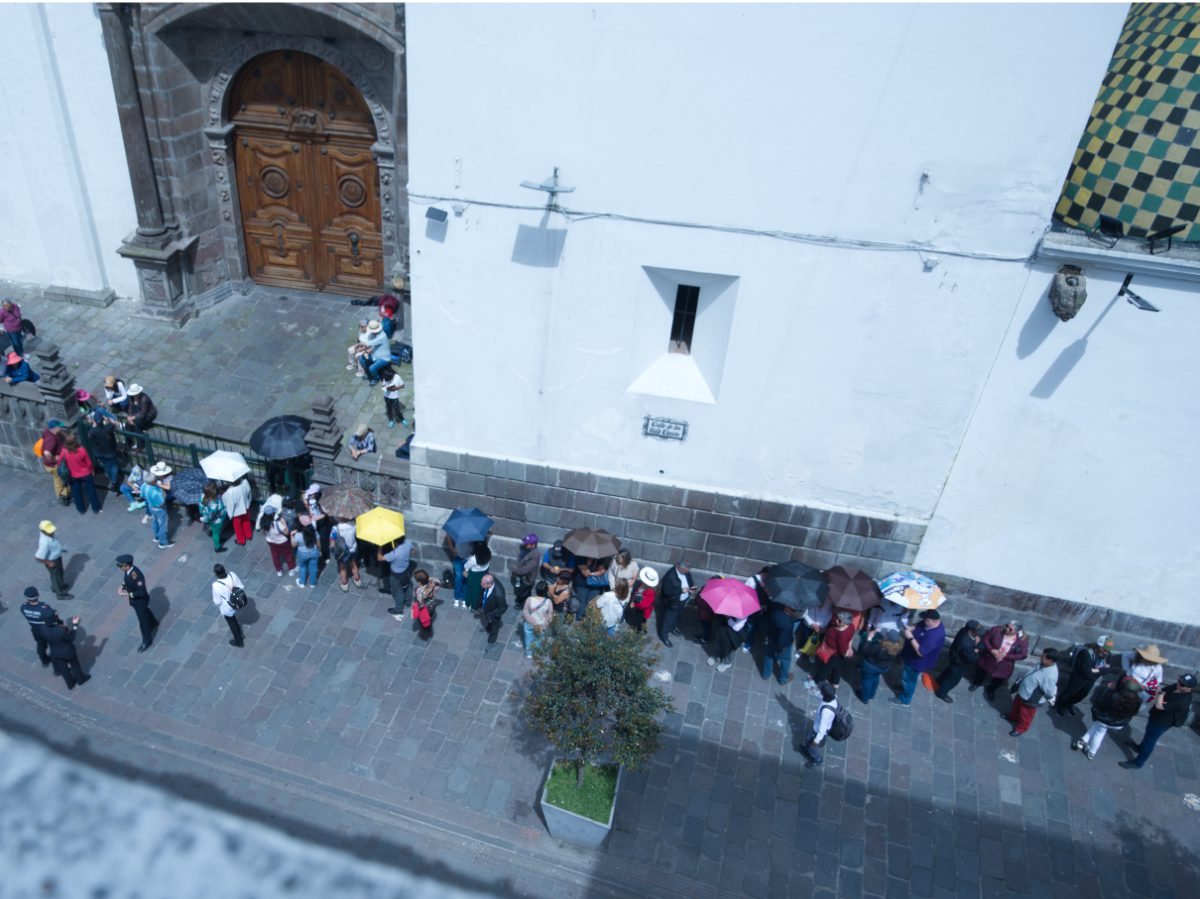
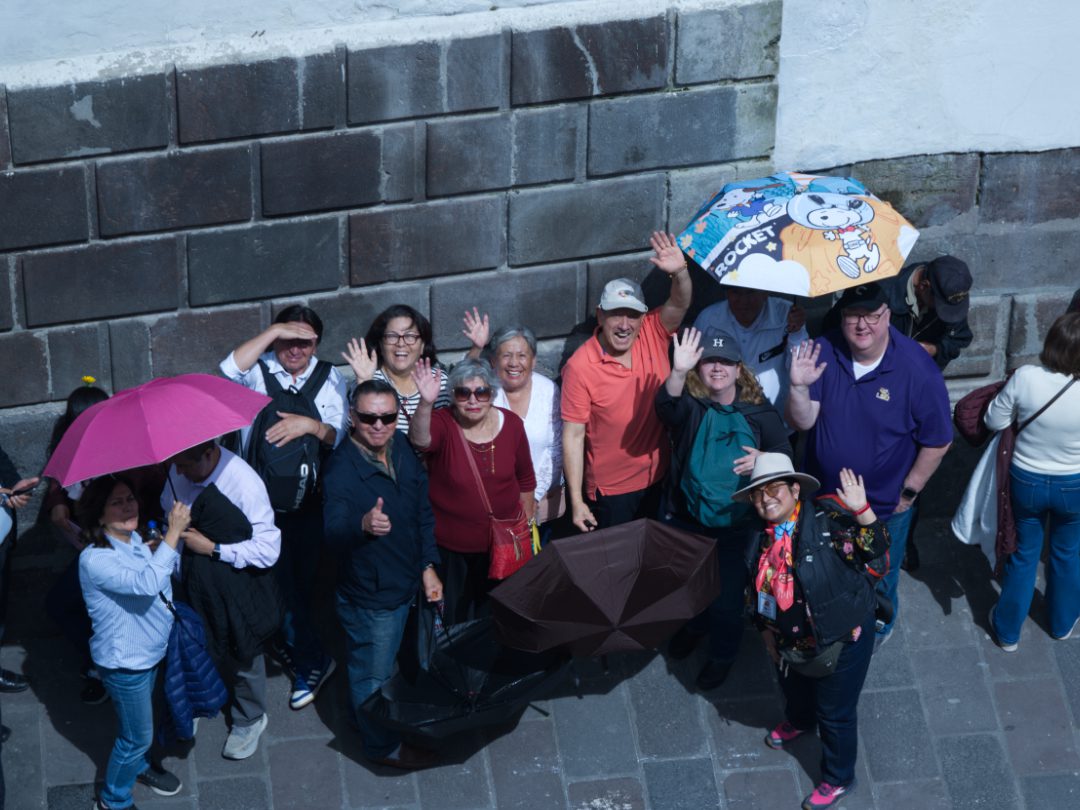
On my first time, I stood in line with a friend outside the cathedral, passing the time with sanduches de pernil bought from vendors in the plaza. There’s a strange mix of anticipation and routine, people chatting, eating, checking the time, all waiting for the doors to open. I recommend arriving before 1 pm for the 4 pm start time.
Smart people come prepared with umbrellas to protect themselves from the harsh sun or a sudden downpour. It is also appropriate to have one or two people stand in line while you leave to go find a bathroom (pro tip: there is one across the street in the cultural center). If you are on your own, ask your nearest neighbor to hold your spot. They won’t mind.
Inside the Quito Cathedral
Once inside, the hierarchy of the space becomes clear.
The front pews are reserved for dignitaries. Everyone else fills in behind them, taking seats as close to the front as they can. This is an orderly procession into the church, if a little rushed. No one is pushing for the best seat… they merely hope to encounter a good one.
Sometimes, they allow more people to enter than can be seated in the pews. These guests stand for the entire ceremony, packed against the walls in a large U-shaped space that leaves space for the procession to come.
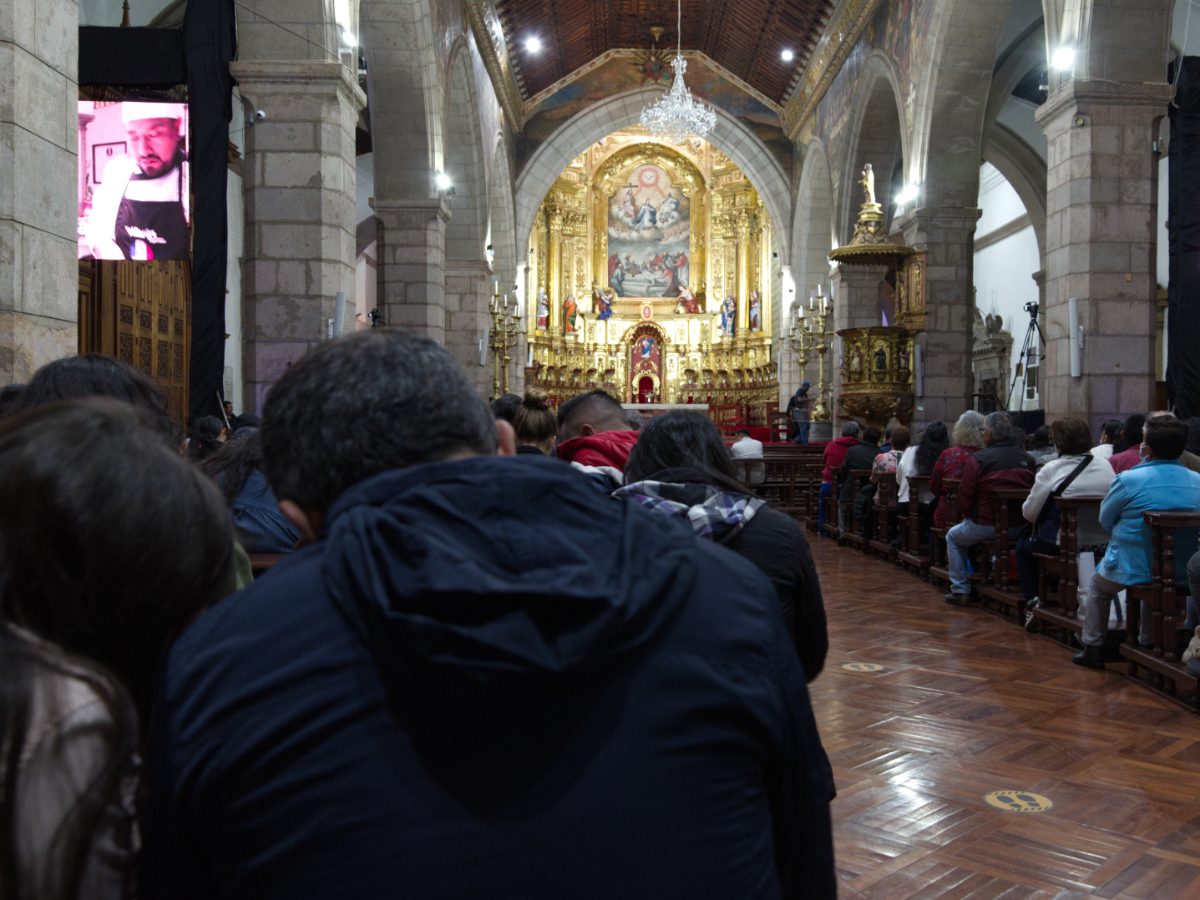
Some might say standing is better as your view might be improved. Sitting in the pews can make it difficult to see the altar, the procession, or both, depending on exactly where you sit. Large television screens placed around the church help.
Add to all of this, the people closest to you will be holding cellphones on high to capture whatever fleeting image possible. It gives you permission to do the same. Take a deep breath and remember, this how Quiteños live in the moment. Just being inside this colonial church for this rare ceremony is a privelege, no matter where you sit or stand.
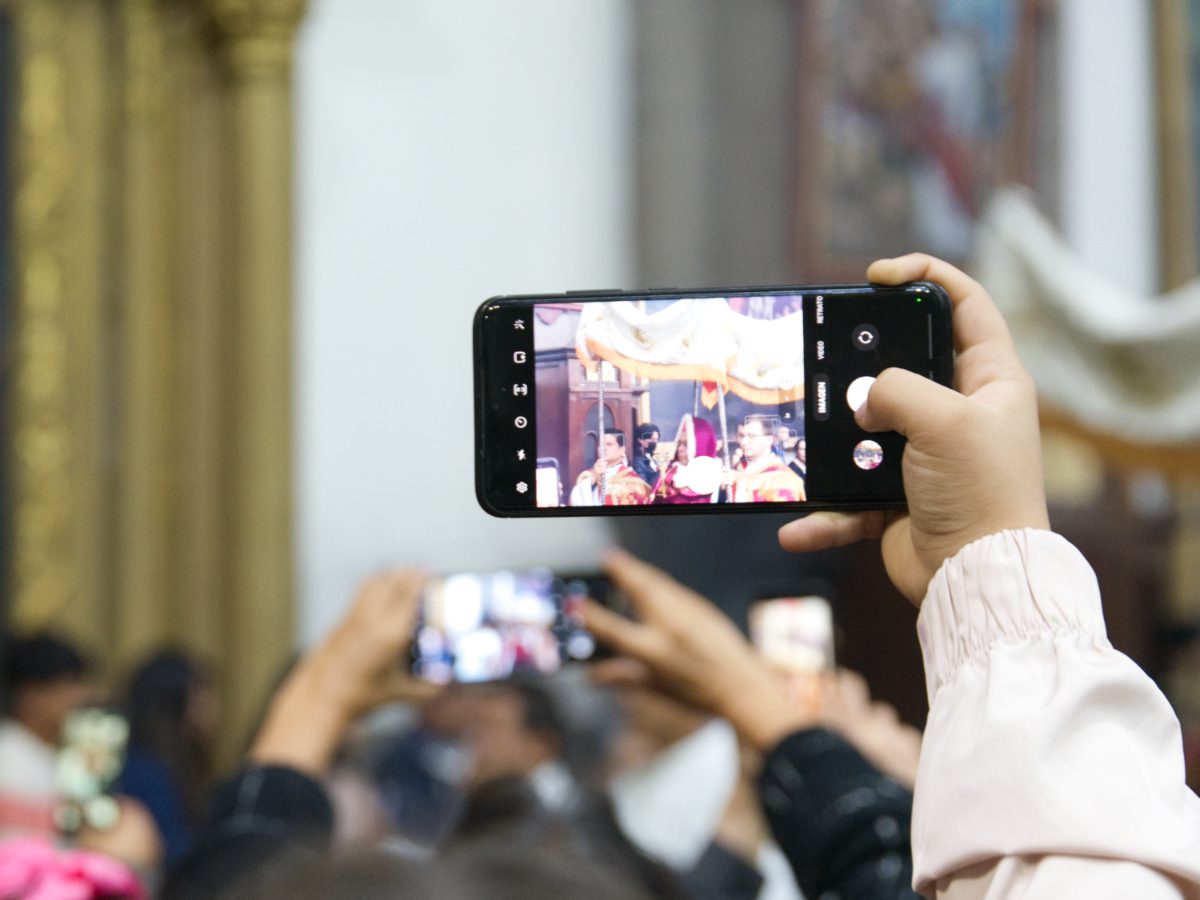
This past year, Scott and I attended with press access through Esto Sí Es Ecuador and our friend Jacqueline Granda.
We entered near the altar and took our places up front near the few invited guests. Not close enough to hold conversations but my perspective of the event was completely different from the time before. Then, I was lucky to see much of the procession unless looking at the large screens set up for easier viewing. It was still impactful, but hard for a short person to see.
The time before the event can drag unless you enjoy people watching. Yet this is an excellent moment to take notice of the artwork that makes the cathedral so special.
Crystal chandeliers hang from a coffered ceiling with Moorish influences. The spaces between the arches are covered in vividly painted murals—scenes that seem to trace the Stations of the Cross. The Last Supper is there… and if you look closely, the meal includes a guinea pig. The main altar is bathed in gold leaf, painted wooden statues and a mural from the Quito School, add to the colonial grandeur of the space.
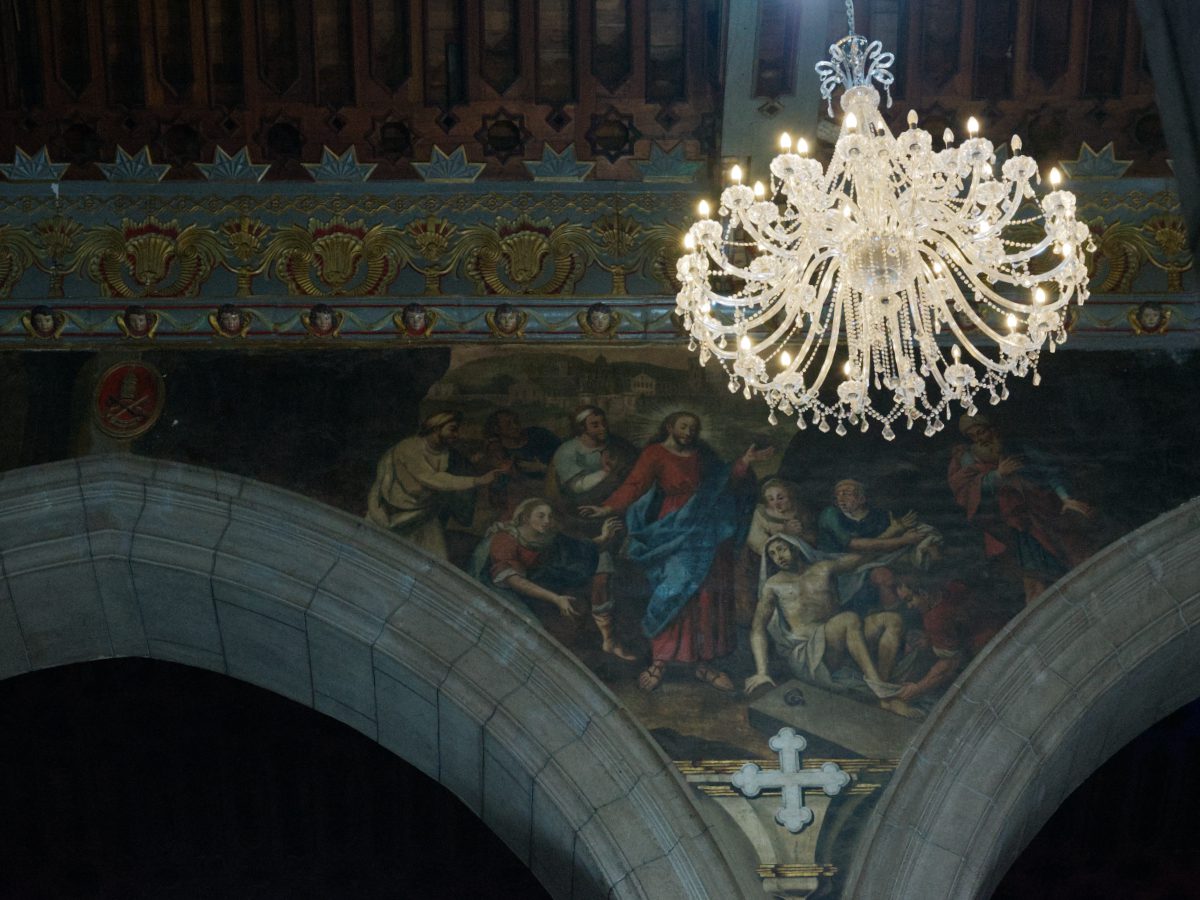
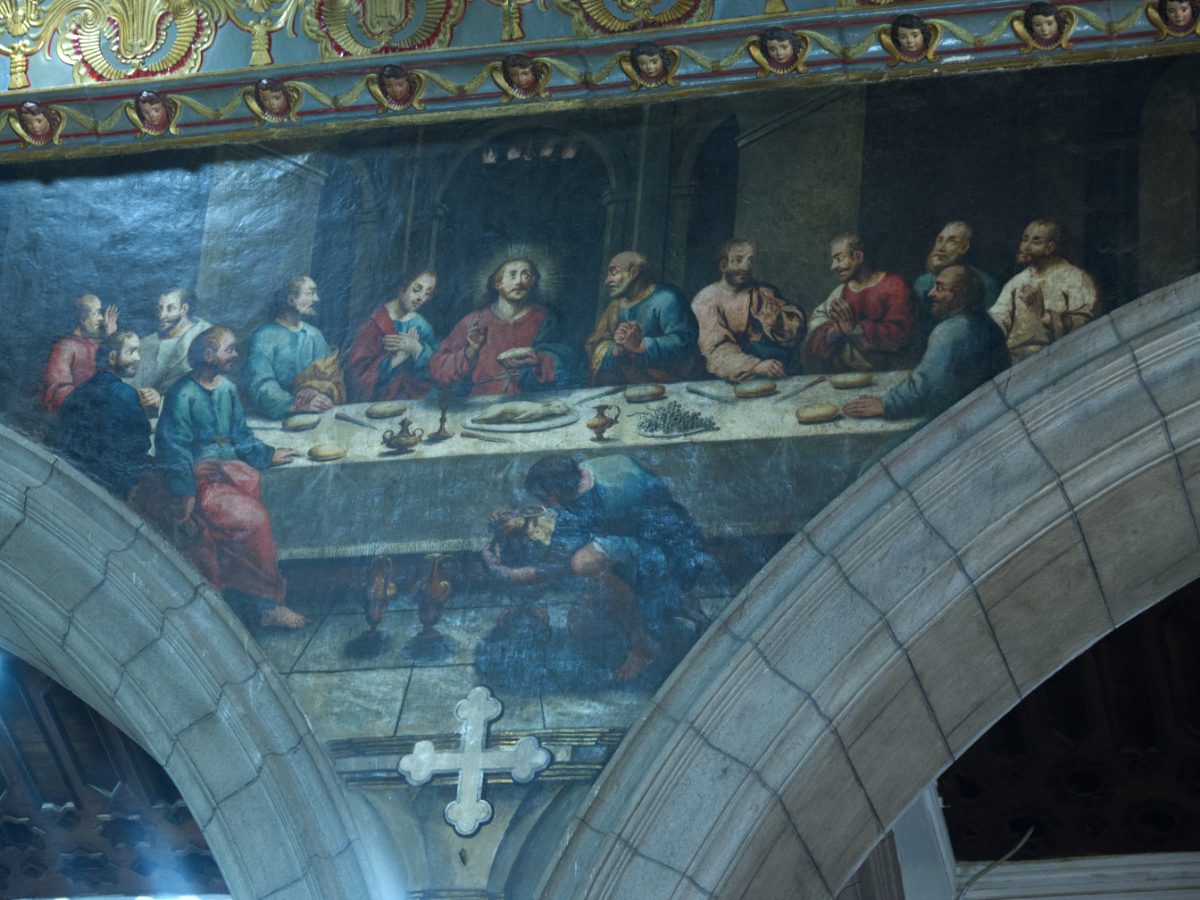
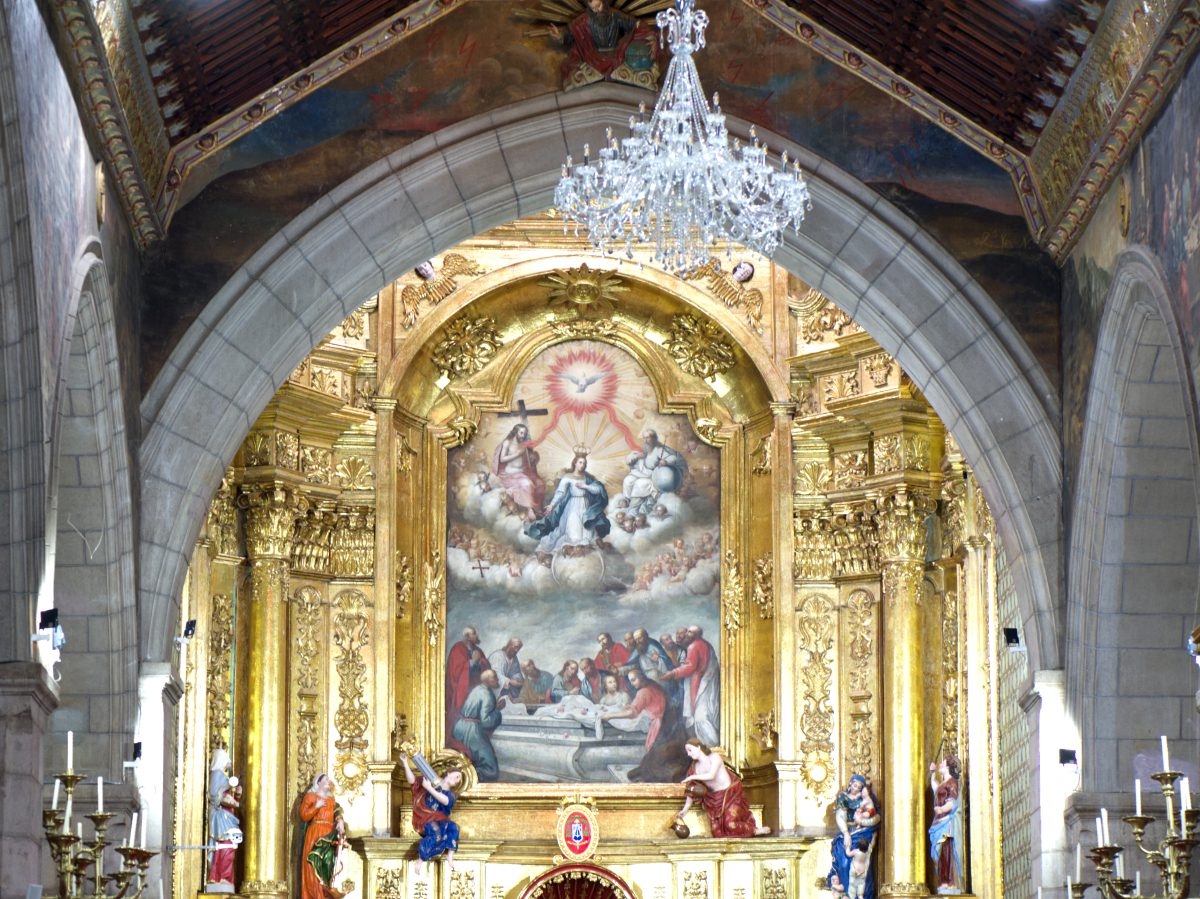
Like so much of colonial Quito, the cathedral and its trappings were built by Indigenous hands under a system that exploited their labor while reserving power and recognition for others. Holding this truth while admiring the beauty is part of our obligation and our experience.
And The Ceremony Begins
As we waited for the ceremony to begin, dignitaries continued to arrive—some at the last possible moment. Priests and acolytes in white robes moved quietly through the space, preparing. Some carried long poles topped with tall white candles. Others laid out plush red cushions along the floor.
Then some unseen signal and everything began.
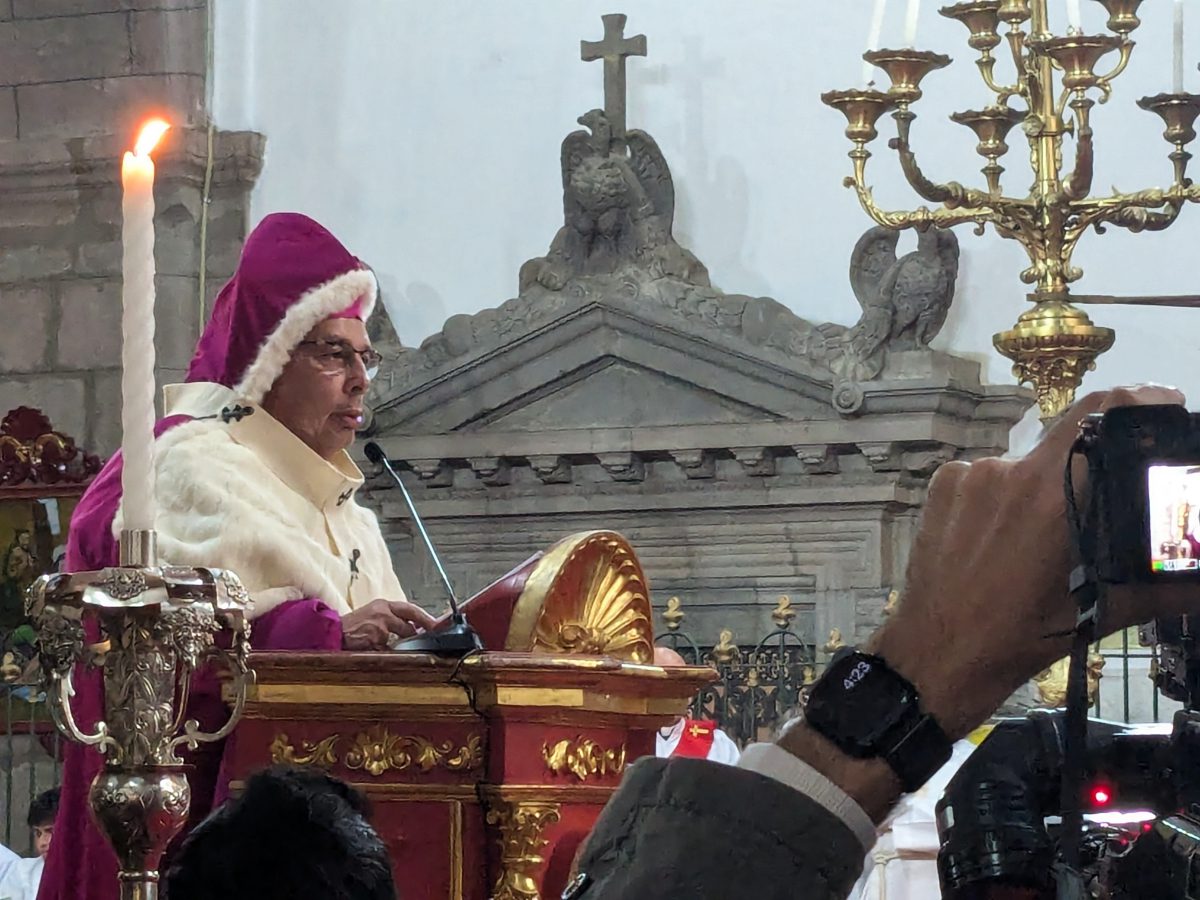
It started with a few words by the Archbishop of Quito, a comment on the current events of the day, the importance of keeping the faith and of practicing traditions. All in smooth Spanish but rapid enough that it was hard for me to understand every word.
The Procession and the Flag
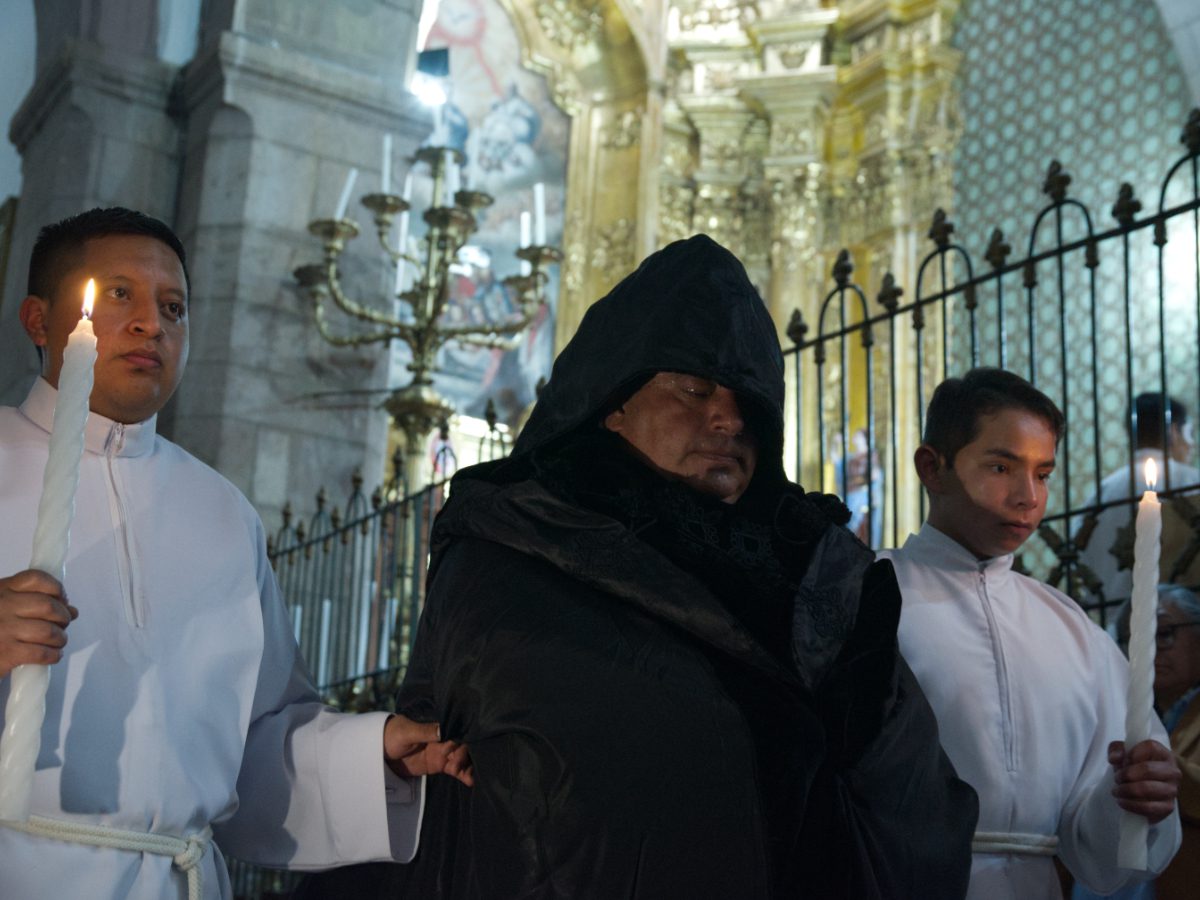
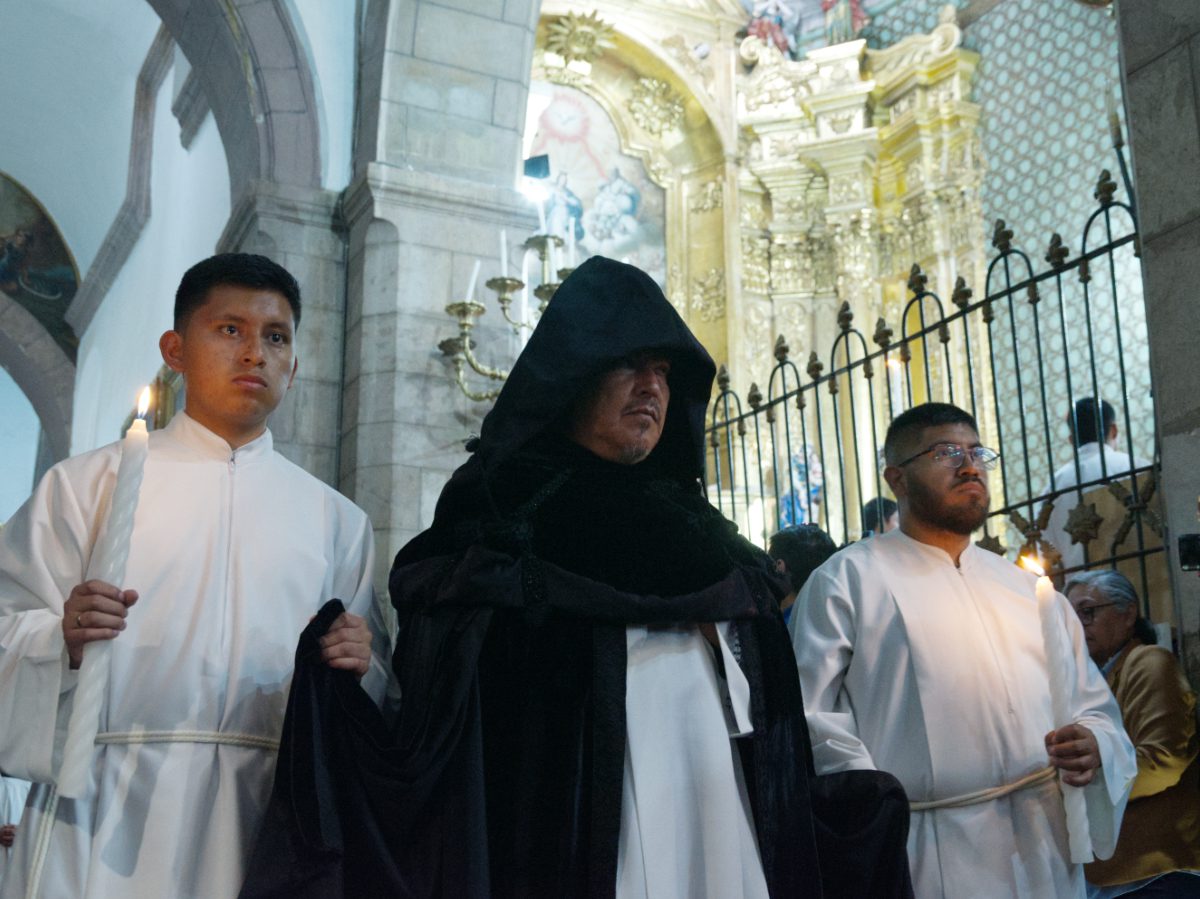
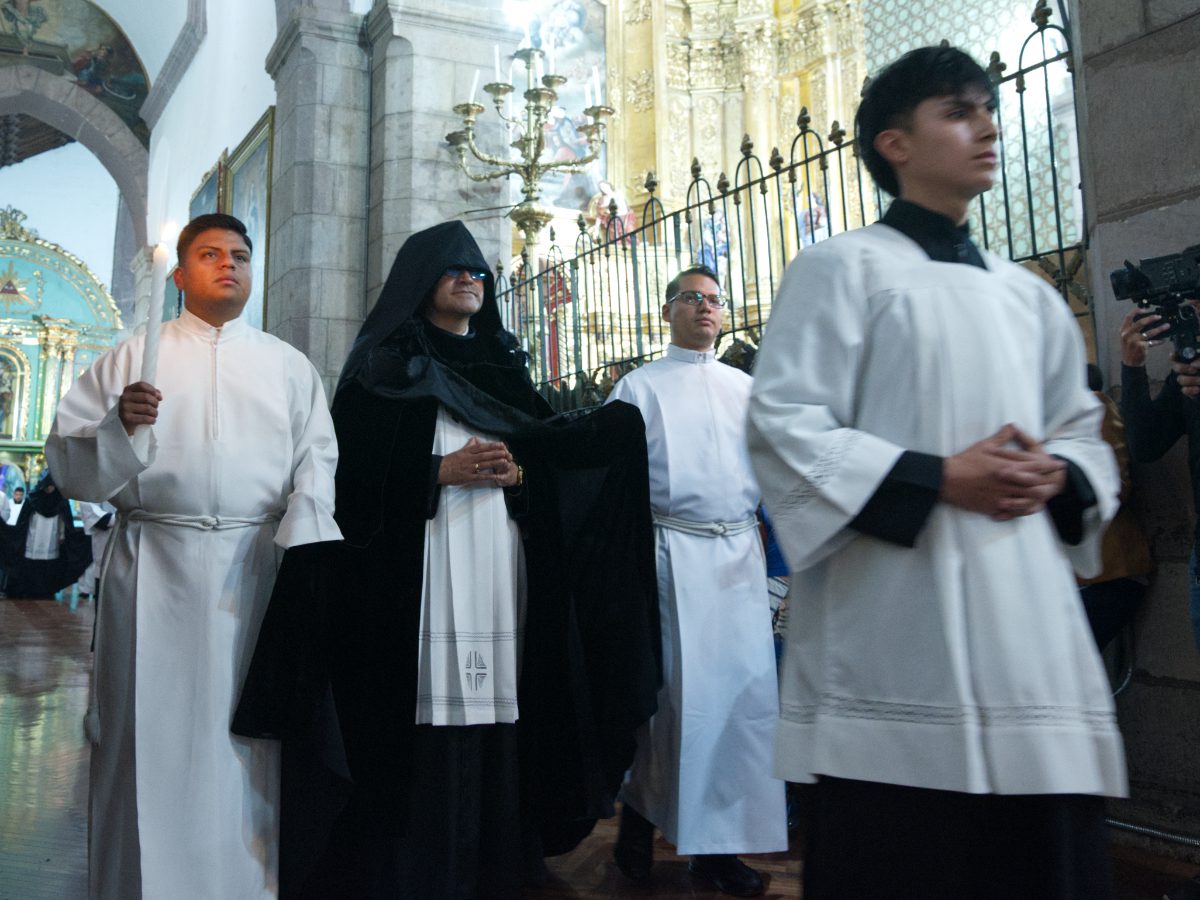
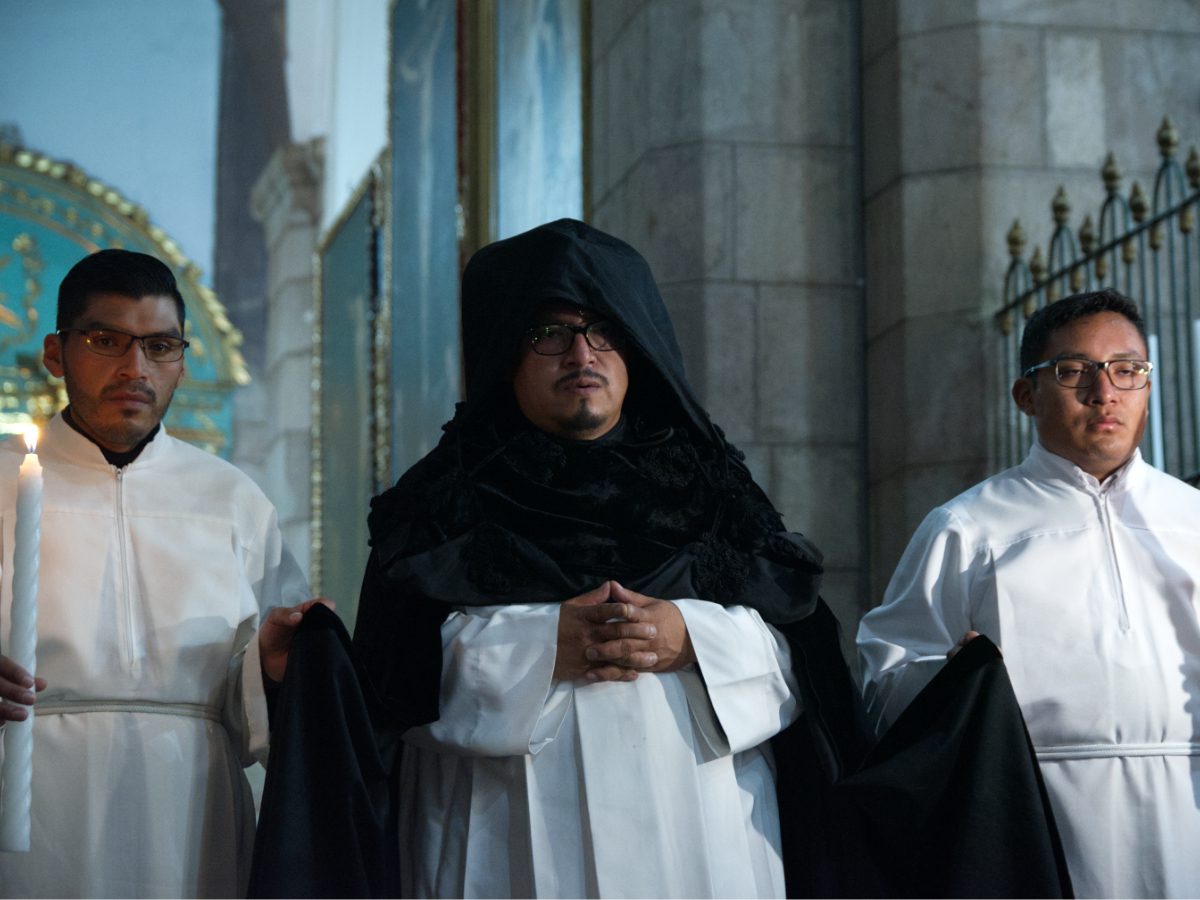
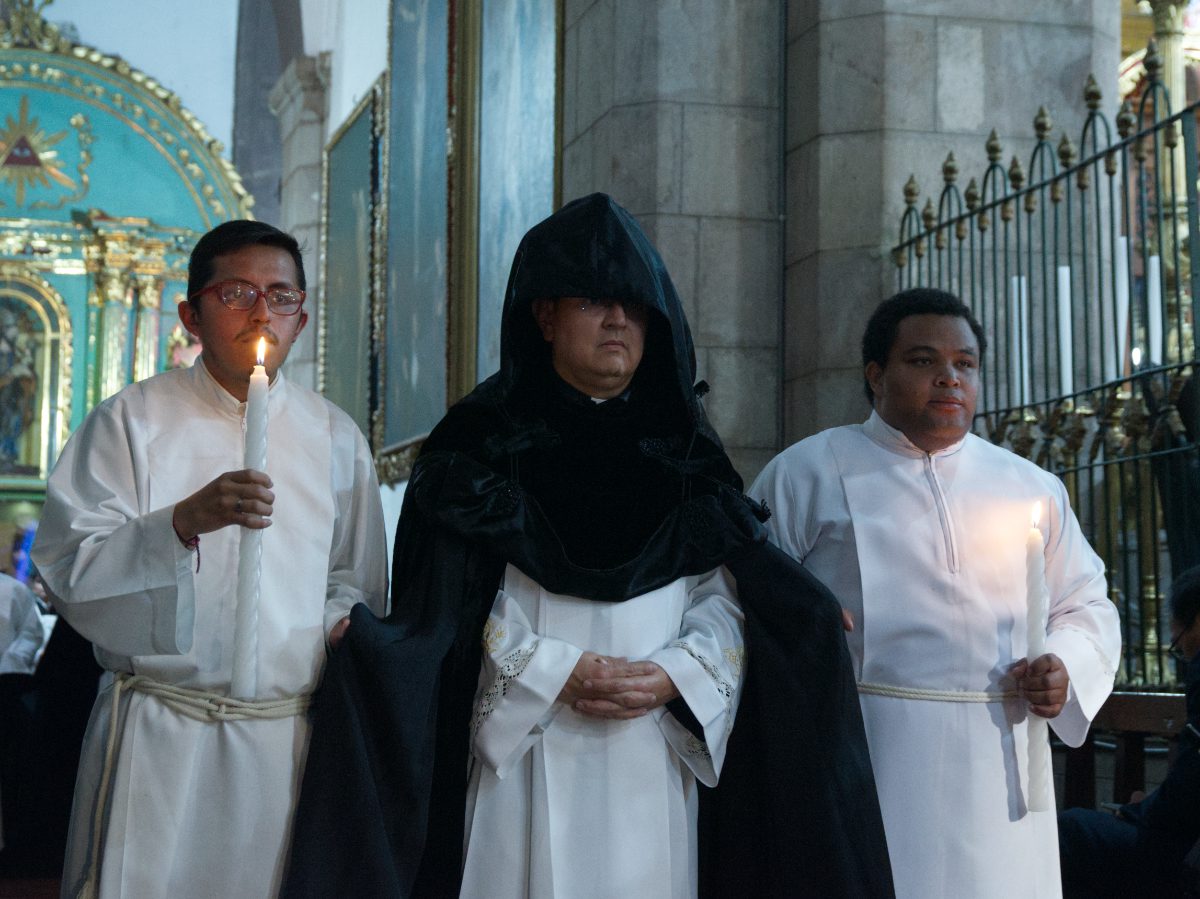
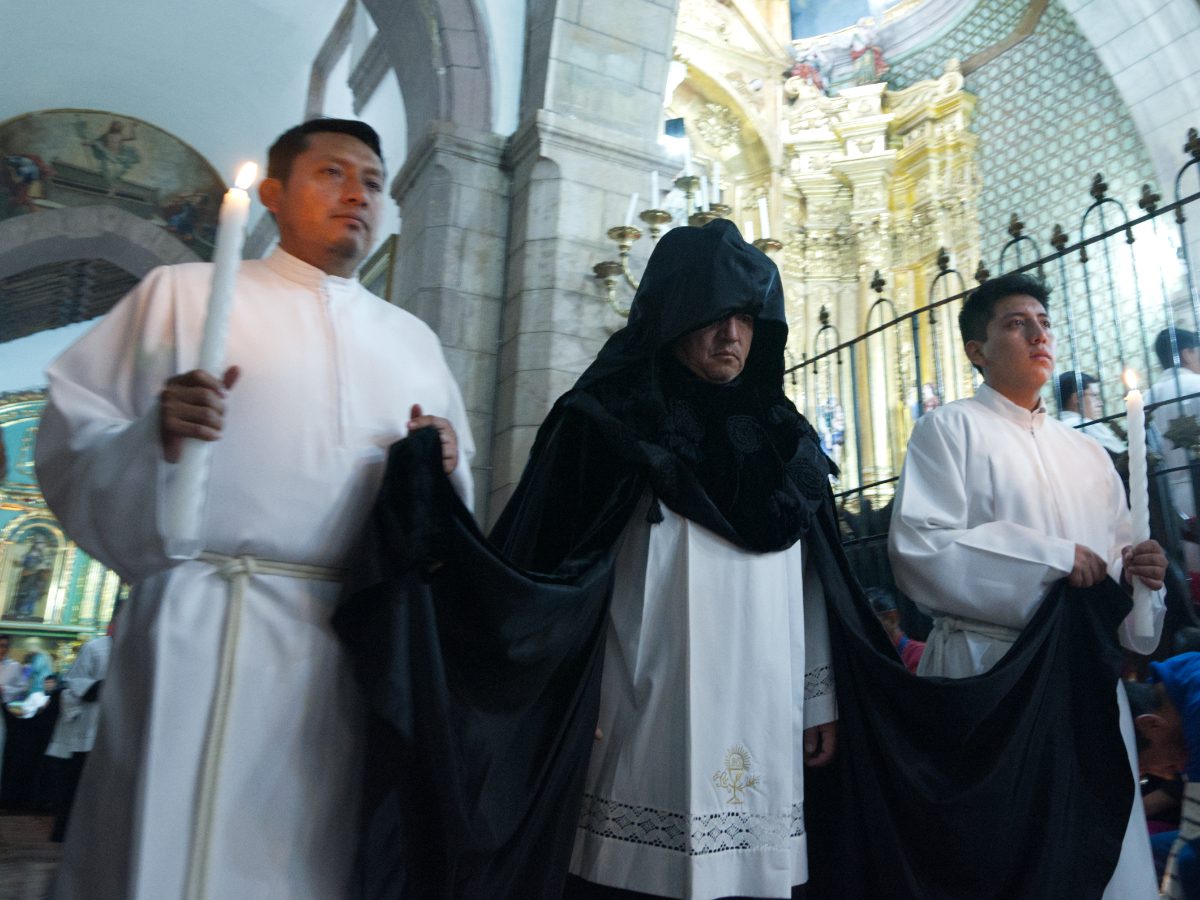
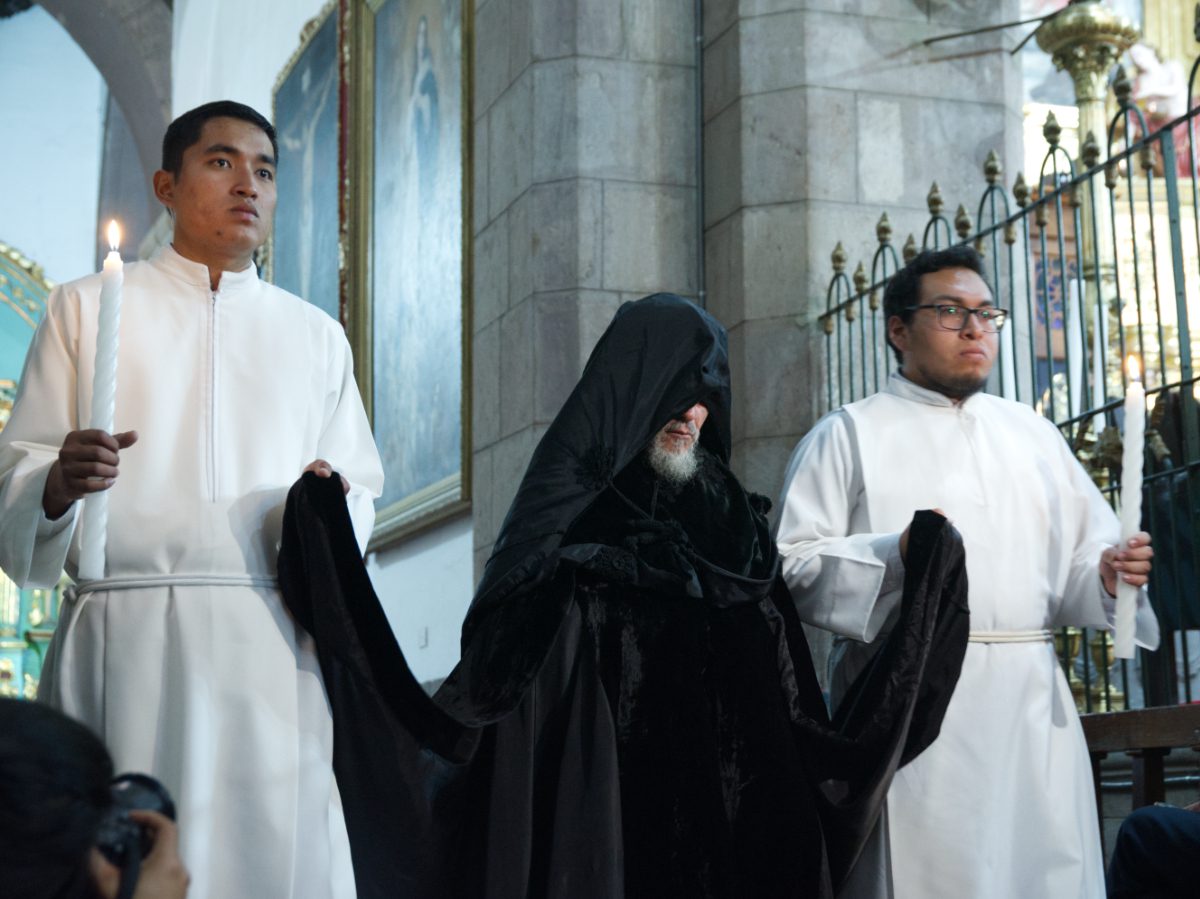
Then, one by one, the canons begin the procession, dressed in black robes, cowls pulled low so their faces are almost hidden. They leave the altar area, pass behind it, turn the corner, and make their way up the left aisle.
Because of their limited sight, each is accompanied by two white-robed priests. Each holds the arm of a canon and, in the other hand, a candle, twisted and white, tall and aflame.
Eight canons pass by, though walk is not the right word. They don’t float. They don’t stroll. Nor do they march. But their steps carry weight without making sound. Behind each of them, a long train of fabric trails across the stone floor, and there it is, the name, Arrastre de Caudas, the dragging of tails.
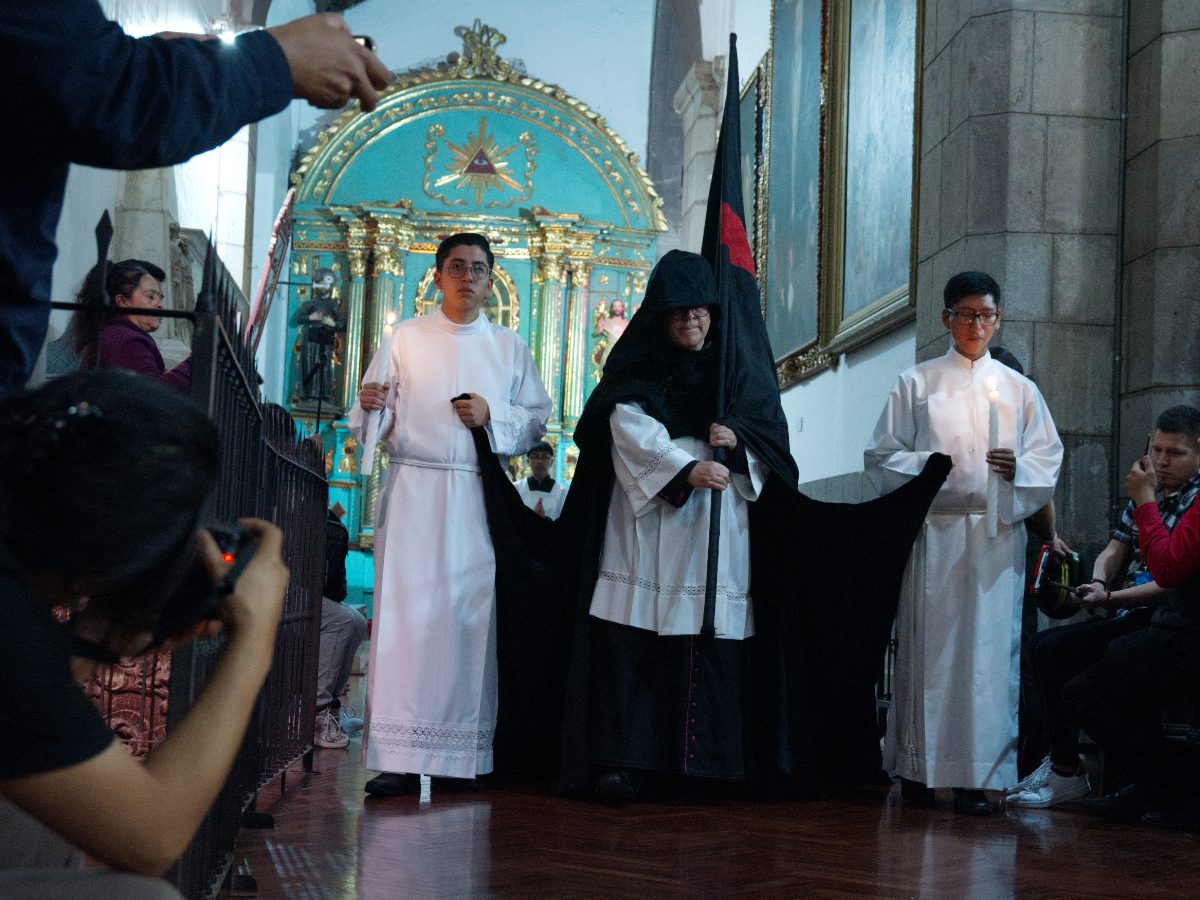
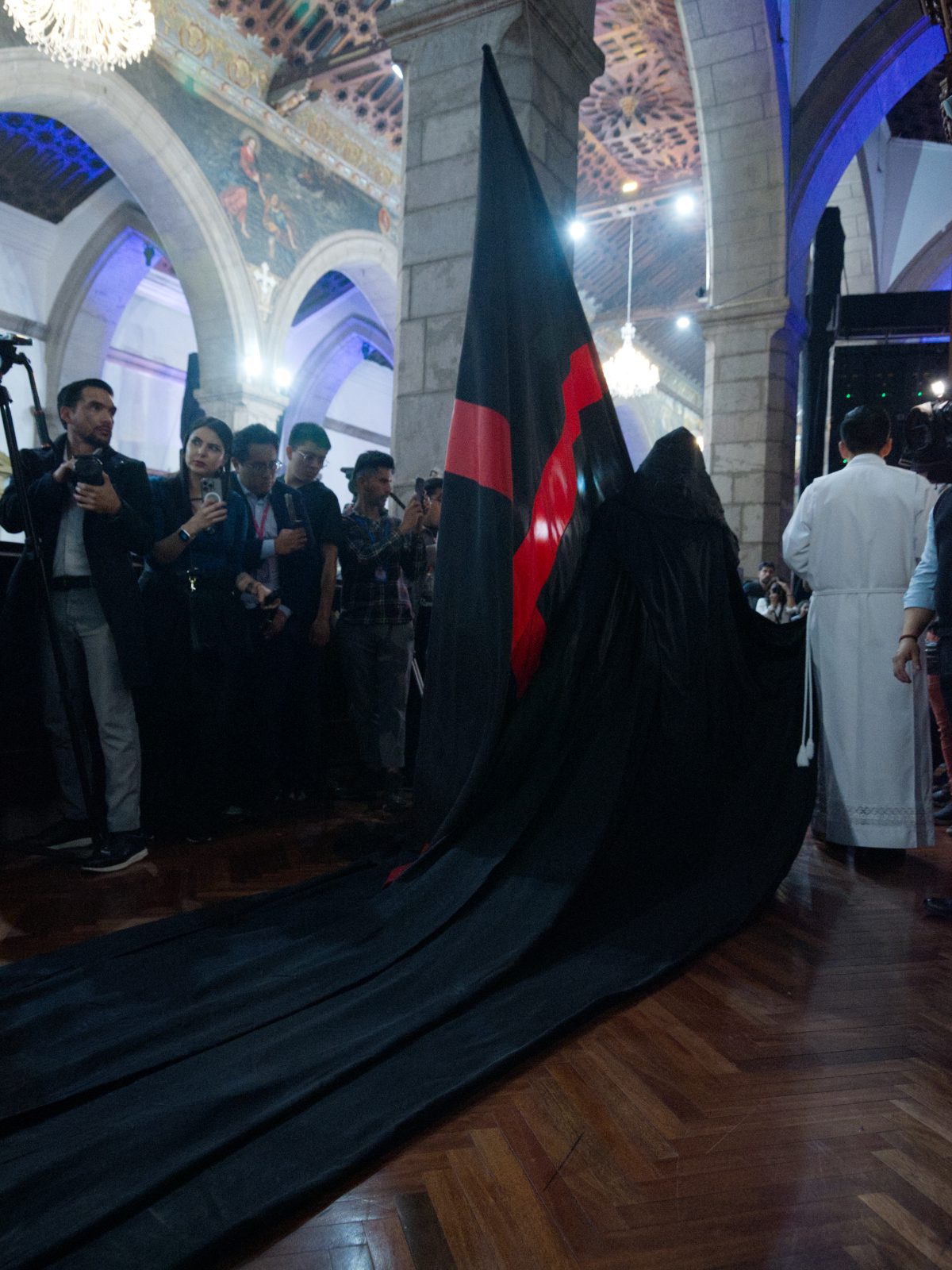
Close to the end of the procession, one of the canon carries an immense, black flag emblazoned with a red cross.
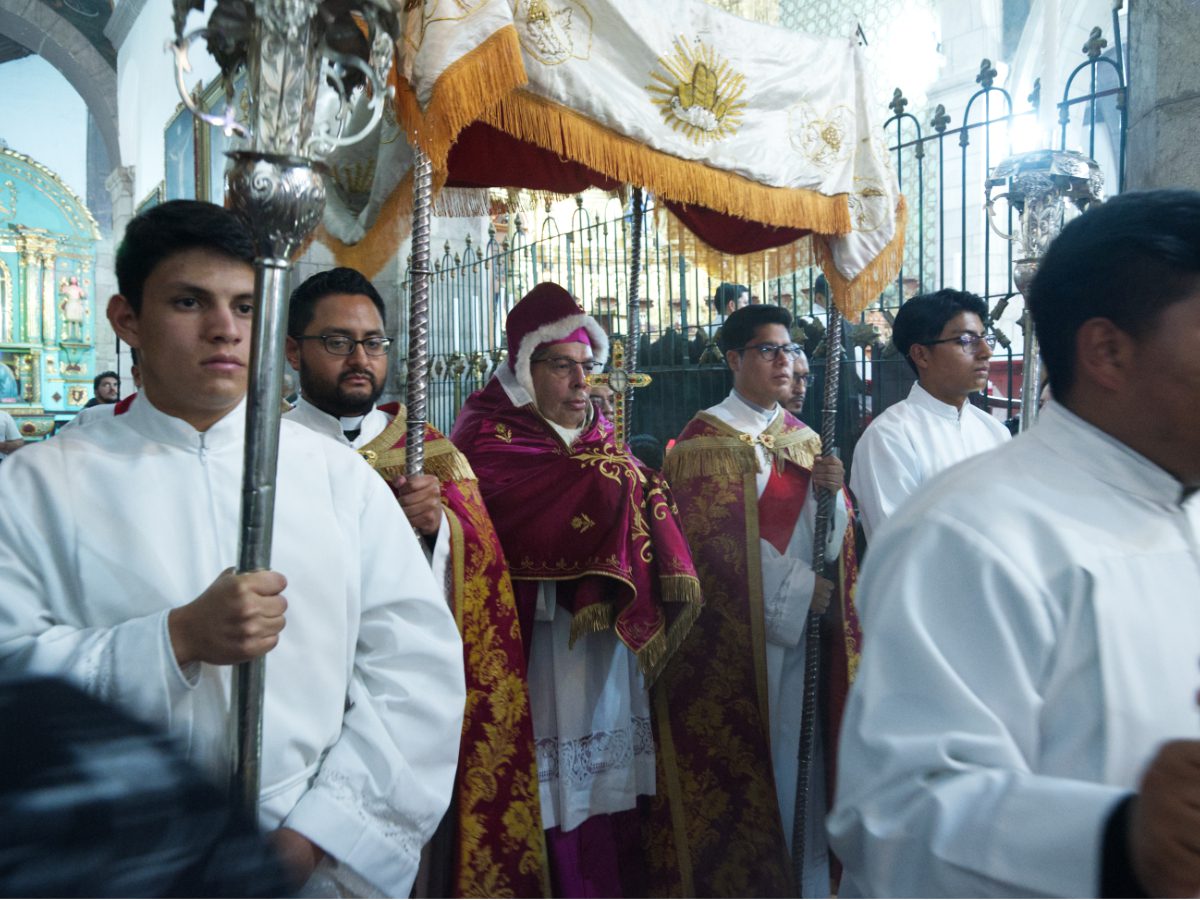
Finally, the Archbishop follows last. He is surrounded by priests, four of them holding a canopy over his head —a baldachin— and he carries a jeweled cross, its center clear, holding what is said to be a fragment of the True Cross.
As I snap pictures, the reverance in the space is visible. I can see it and feel it at the same time. Perhaps it is the funeral march accompanying the procession, a sound that reverberates in the chest and the head as well as the ears. Or is it simply the holy relic and its impact on us all?
One by one, the black-robed canons return to the space in front of the altar. With the help of white-robed assistants, each bows, then moves toward one of the red cushions laid out earlier.
At first, I assumed the cushions were for kneeling. They aren’t.
The assistants move quickly, adjusting hoods, guiding canons to their places. Then, almost all at once, the black-robed figures lower themselves completely, prostrating on the ground. Their faces rest on the cushions.
The people are silent but the music persists.
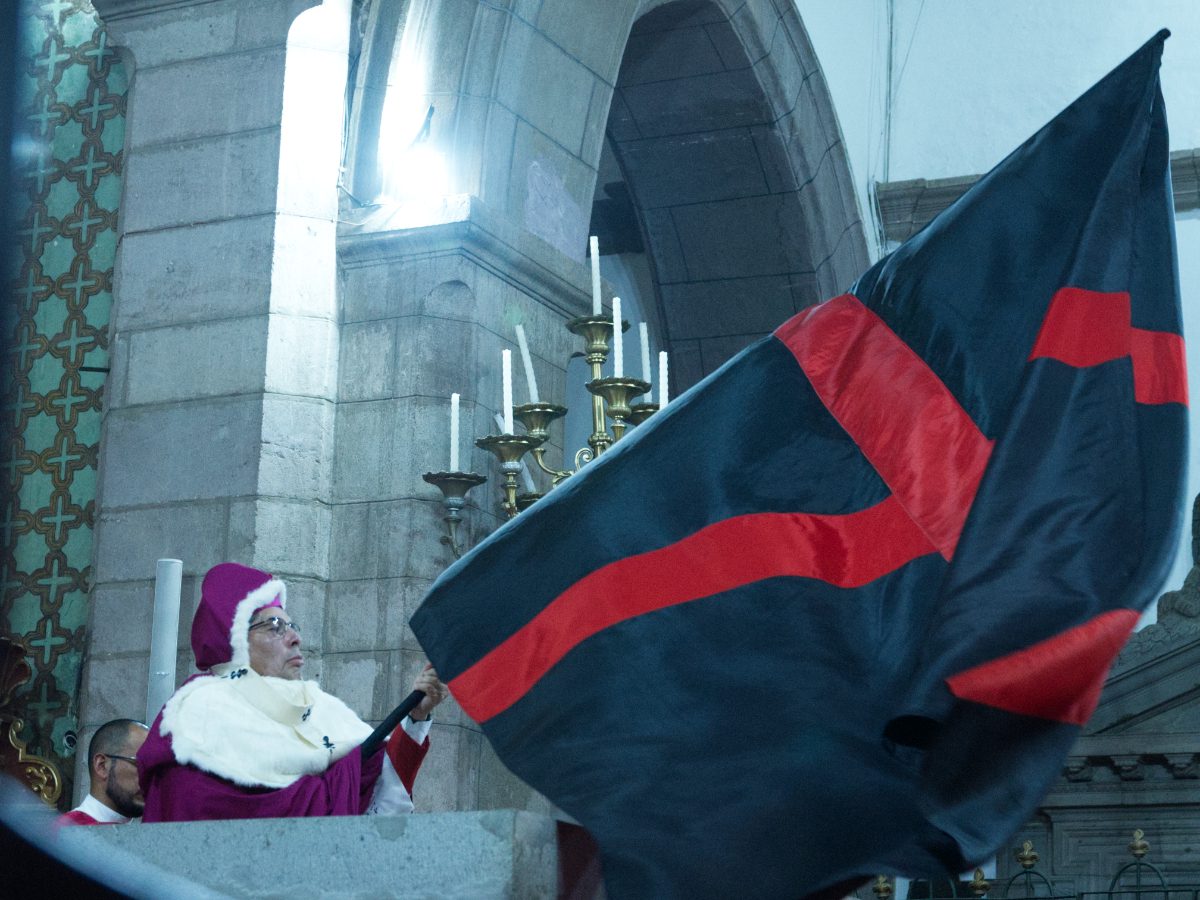
When the Archbishop raised the flag, I finally understand its scale. It doesn’t just cover the altar—it dwarfs it. He waves it back and forth, his arms seemingly unbothered by its weight but I can only imagine the strength it takes to keep it moving back and forth.
He steps down from the alter and walks between the flattened bodies, following the path left open for him. Slowly, deliberately, he passes the flag over all of them.
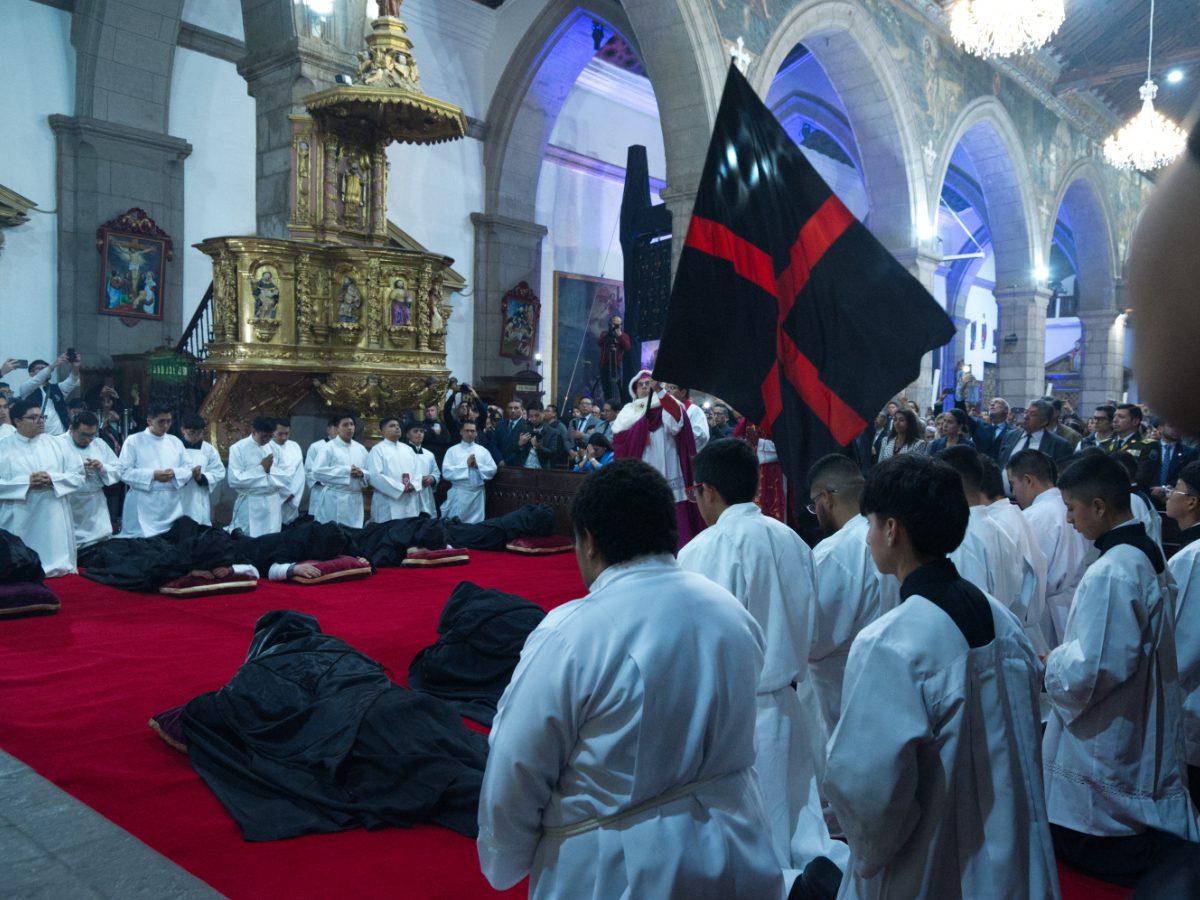
When he’s finished, he returns to the altar.
The black-robed figures rise and follow.
It almost anti-climactic. You sense that moment when all adrenaline leaves your body and you are left with this malaise. Something incredible has taken place and your mind has yet to catch up with itself.
And then—it’s over.
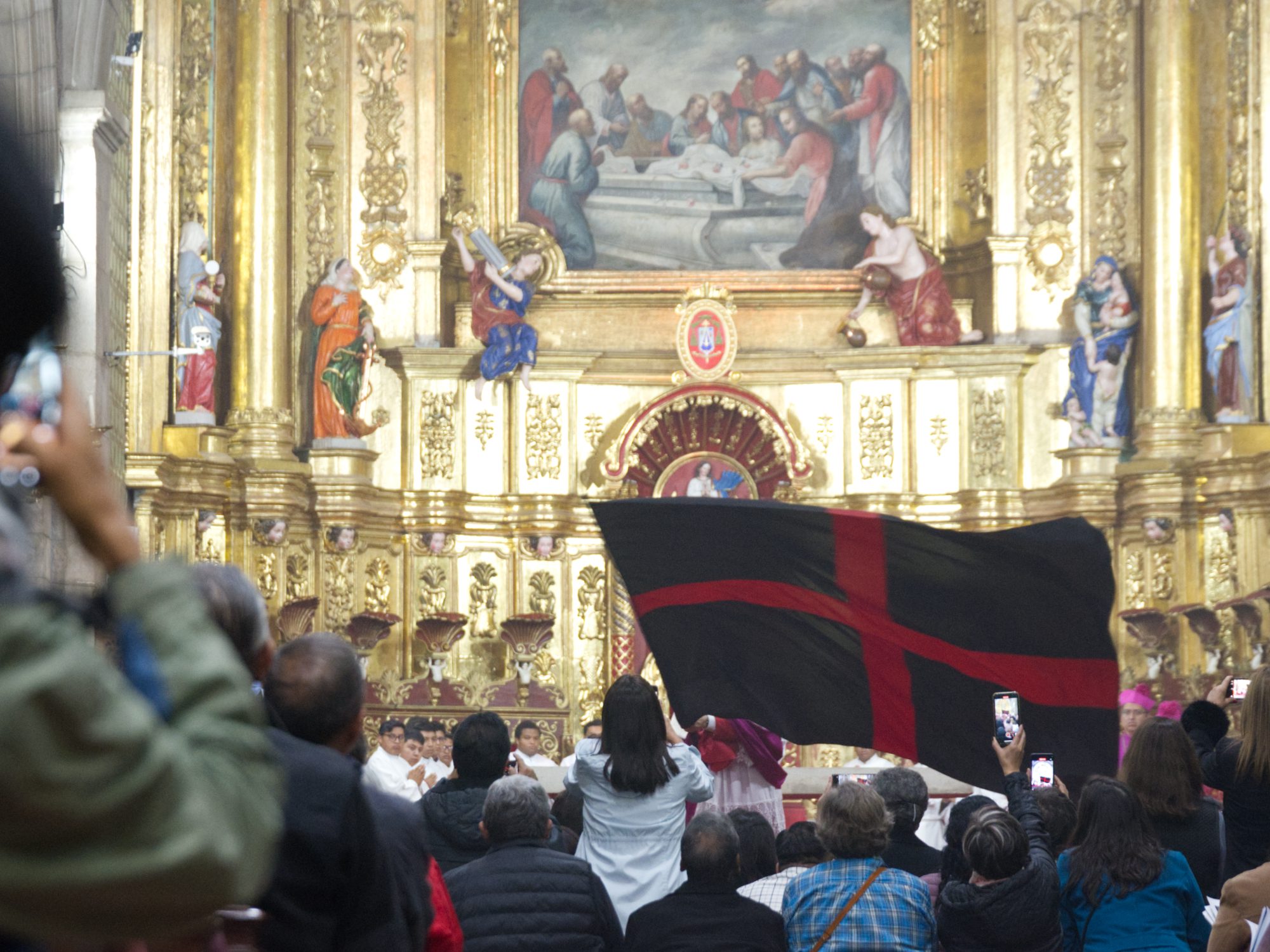
The Arrastre de Caudas is not an event I will ever fully understand.
But it offers a window into a form of faith that is layered, contradictory, and deeply rooted in history. It’s not mine. But it is something I can witness and share. And maybe that’s the point.
Religious tourism isn’t always what people expect it to be. It isn’t just about stepping into beautiful spaces or observing traditions from a comfortable distance. Sometimes, it asks you to sit with something that feels unfamiliar, complicated, even uneasy.
Not everything resolves neatly.
But if you’re willing to stay with that discomfort, there is something real there, something that goes far beyond the surface. If you choose to experience Holy Week in Quito, then open yourself to this opportunity for discomfort. You may leave with more questions than answers. But something in you might change.

Deja una respuesta